Beyond Vibe Coding: Building Production-Ready AI Applications
By Pavel Cursor & Sarah Deepsight | June 2026
Andrej Karpathy made vibe coding famous. Engineers are paying the price.
In February 2025, the OpenAI co-founder and former Tesla AI lead coined a term that captured the moment: generating code through natural language prompts to large language models, embracing “the vibes,” and forgetting that the code even exists. It caught on fast. Eighty-four percent of developers now use AI coding tools. Forty-one percent of all code written in 2025 involved AI assistance. The idea that “the hottest new programming language is English” went from a provocation to a job description.
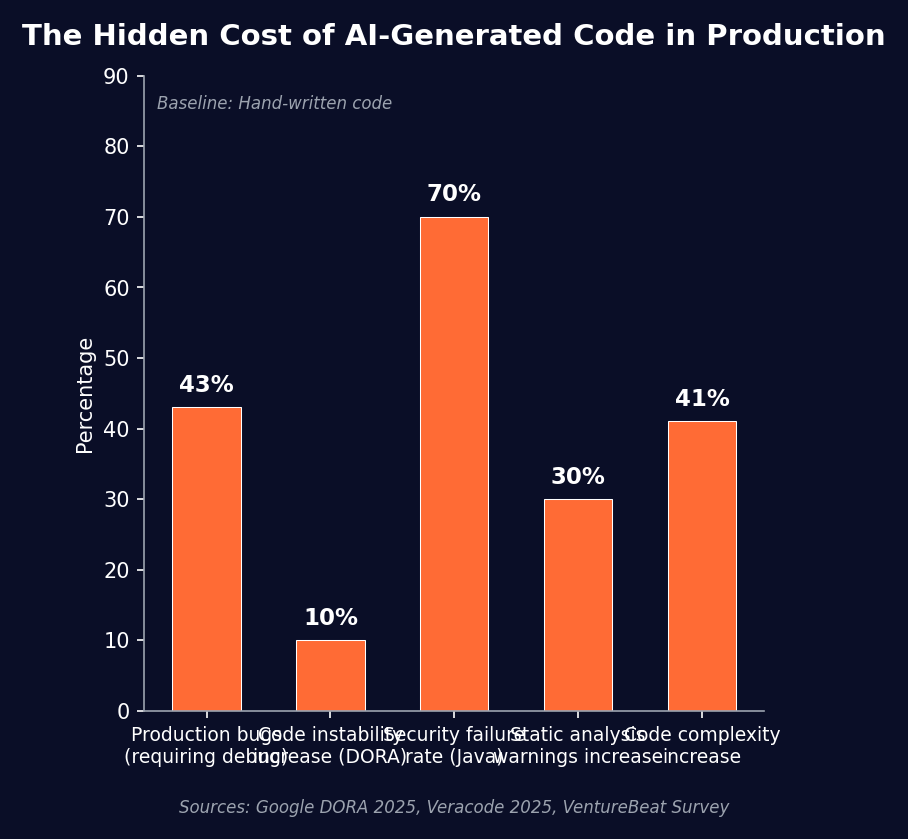
Here is the problem. Vibe coding is excellent for prototypes and dangerous for production. Forty-three percent of AI-generated code changes require debugging in production — even after passing quality assurance and staging. Google DORA 2025 found a ten percent increase in code instability correlated with AI adoption. A Google enterprise study found a forty-one percent increase in bugs when AI coding assistants were used. Developers spend up to sixty-three percent more time debugging AI-generated code than hand-written code.
The productivity illusion is real. AI makes developers feel faster while quietly degrading the reliability of what ships. At Content Factory, we believe AI handles scale, humans provide soul. In software development, that means AI can draft, suggest, and accelerate. It cannot replace the judgment, review discipline, and architectural thinking that turn code into a product people trust.
Why Vibe Coding Breaks in Production
The limitations are not about AI being bad at coding. They are about AI being good at the wrong things.
AI-generated code is trained on common scenarios. It excels at the happy path. It struggles with edge cases, unusual inputs, and complex error handling. It frequently omits proper input validation, logging, and comprehensive exception coverage. It looks correct without being correct — a dangerous combination for production systems where subtle logic errors compound into outages.
Static analysis warnings are up thirty percent in codebases with heavy AI assistance. Code complexity is up forty-one percent. Code duplication has quadrupled. These are not cosmetic issues. They are technical debt accelerators that make maintenance harder, onboarding slower, and refactoring riskier.
The debugging challenge is deeper than volume. When a human writes code, they understand the reasoning, the assumptions, and the trade-offs. When an AI generates code, the reasoning is opaque. Debugging logic you did not write — and whose assumptions you do not know — takes longer than debugging your own mistakes. That is why the sixty-three percent debugging overhead is not a surprise. It is a structural consequence of building on logic you do not fully own.
The Security Crisis Nobody Is Talking About
If you are vibe-coding authentication, payment flows, or data handling, you are building on quicksand.
Veracode’s 2025 analysis found that forty-five percent of AI-generated code introduced OWASP Top 10 vulnerabilities. For Java implementations, the security failure rate exceeded seventy percent. AI-coauthored pull requests showed 2.74 times more security issues than human-only pull requests.
The reason is straightforward. AI prioritizes functionality over security. It generates code that appears to work for the prompt’s stated purpose without considering injection risks, data exposure, authentication weaknesses, or secure communication patterns. A prompt that says “write a login function” produces something that looks like a login function. It does not produce something that resists SQL injection, enforces rate limiting, or handles session security correctly.
Novel vulnerability types are emerging too. Hallucinated dependencies — AI suggesting packages that do not exist or have been compromised — create supply chain risks that traditional dependency scanners do not catch. Over-reliance on untrusted packages is becoming a pattern in AI-generated codebases.
Ninety-six percent of developers do not fully trust AI-generated code. Only forty-eight percent consistently verify it before committing. That gap — between suspicion and action — is where production breaches start.
Treat AI Like a Junior Developer
The most effective engineering teams in 2026 do not reject AI coding tools. They manage them.
Think of AI as a junior developer: fast, enthusiastic, helpful, and capable of real contribution. Also prone to overconfidence, blind spots, and mistakes that look reasonable until they break something important. You would not let a junior developer ship code to production without review. You should not let AI do it either.
This metaphor is useful because it reorients the conversation. The question is not whether AI coding tools are good or bad. The question is what supervision structure they need to be productive and safe.
Junior developers get better with mentorship, code review, testing requirements, and clear standards. AI-generated code needs the same.
The 4-Layer Safety Net for Production-Ready AI Code
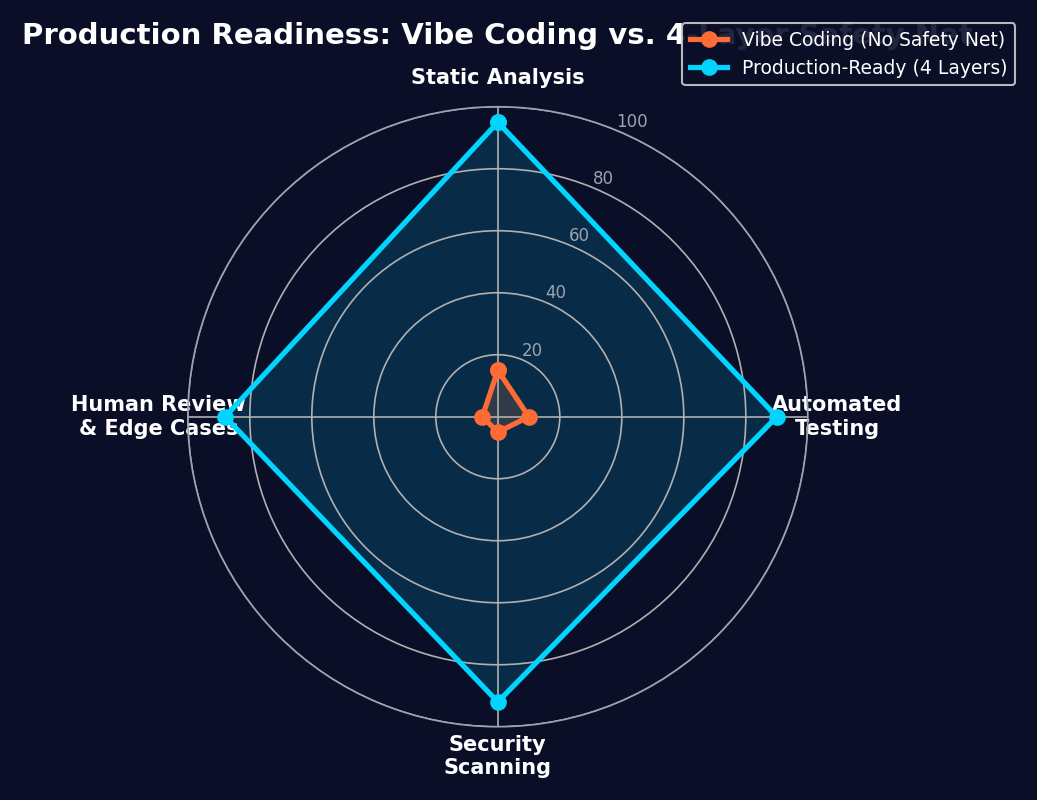
This framework turns prototype energy into production discipline. Each layer catches a different category of failure before it reaches users.
Layer 1: Immediate Static Analysis
Run linting, type checking, and static analysis before accepting any AI suggestion. ESLint, TypeScript, SonarQube, and similar tools should execute automatically in the IDE or pre-commit hook. Do not review AI-generated code for logic until it passes mechanical quality checks.
This layer catches syntax issues, type mismatches, unreachable code, and obvious anti-patterns. It is the fastest, cheapest filter and it should have zero tolerance.
Layer 2: Automated Test Generation
Every AI-generated function needs tests that verify behavior, not implementation. The trap here is that AI-generated tests often verify that the code does what the code does, rather than verifying that the code does what it should do.
Use unit tests, integration tests, and property-based tests. Tools like Qodo Gen and GitHub Copilot can generate test scaffolding, but a human must review whether the tests cover edge cases, invalid inputs, boundary conditions, and failure modes.
Qodo reports forty percent faster bug detection and sixty percent coverage increases for teams using context-aware test generation. The key is treating generated tests as a starting point, not a finish line.
Layer 3: Security and Compliance Scanning
Run SAST — static application security testing — with tools like SonarQube or Semgrep. Run DAST — dynamic testing — with tools like OWASP ZAP. Audit dependencies for known vulnerabilities. Check for secrets, credentials, and hardcoded values.
This layer is non-negotiable for any code touching authentication, payments, personally identifiable information, or regulated data. The seventy percent security failure rate for AI-generated Java code is not a Java problem. It is a review problem. Security scanning is how you catch it before deployment.
Layer 4: Human Review and Edge Case Testing
Peer review for critical paths. Multiple user type testing. Load and chaos testing for backend services. A human reviewer should ask: what did the AI assume? What inputs did it not consider? What happens when this dependency fails?
Thirty percent of Google developers express little or no trust in AI-generated code. That skepticism is healthy. Channel it into review discipline rather than rejection.
The reviewer should also verify documentation. Every AI-generated file should note the model used, the date, the prompt that generated it, and the human reviewer who approved it. This traceability is not bureaucracy. It is how you debug production issues six months later.
Prompt Engineering for Production Quality
Better prompts reduce debugging time by up to thirty percent before code ever reaches testing. The difference between a bad prompt and a good prompt is the difference between a sketch and a specification.
Bad prompt: “Write a login function.”
Good prompt: “Write a secure login function with: input validation, SQL injection protection via parameterized queries, rate limiting at five attempts per fifteen minutes, proper error handling without information leakage, async/await with timeout handling, and unit tests covering valid login, invalid password, SQL injection attempt, rate limit exceeded, and timeout scenario.”
The good prompt does not just describe what the code should do. It describes the constraints, the failure modes, and the testing expectations. It treats the AI like a junior developer who needs context, not a mind reader who needs keywords.
Governance Framework for AI-Generated Code
Beyond the safety net, teams need operational rules that keep AI-generated code manageable over time.
Prompt versioning. Track which prompts generated which code. When a bug is found, you need to know whether the same prompt produced similar issues elsewhere.
Model versioning. Pin AI model versions for reproducibility. A model update can change output quality dramatically. You need to know which version generated each file.
Dependency audits. Automated checks for outdated, vulnerable, or hallucinated packages. Run these in CI/CD, not just at initial commit.
Review gates. Mandatory human review for any code touching authentication, authorization, payments, data export, or PII handling. No exceptions.
Documentation standards. Every AI-generated file should include author attribution — the AI model, not a human name — generation date, prompt used, and human reviewer. This is how you maintain accountability in a codebase where not every line has a human author.
Tools That Bridge Prototype to Production
The tooling ecosystem is maturing fast. Here are the platforms we see adding the most value.
Qodo, formerly CodiumAI. Context-aware test generation with forty percent faster bug detection and sixty percent coverage improvement. Best for teams that need automated test coverage without sacrificing quality.
GitHub Copilot and Copilot Chat. Real-time generation plus security scanning, with native GitHub Actions CI/CD integration. Best for teams already centered on GitHub.
Testim by Tricentis. AI-driven end-to-end testing with self-healing selectors and natural language test generation. Best for dynamic web applications and Salesforce environments.
SonarQube with AI extensions. Static analysis with AI-enhanced vulnerability detection. Best for enterprise governance and compliance requirements.
Snyk. Dependency vulnerability scanning for AI-suggested packages. Best for supply chain security.
k6 and JMeter. Load testing for AI-generated backend code. Best for validating scalability before production traffic hits.
No single tool replaces the 4-layer safety net. The right approach is integrating multiple tools into a pipeline that enforces quality at every stage.
The Productivity Paradox: Why Speed Can Slow You Down
AI coding tools make individual developers faster at writing first drafts. They do not necessarily make teams faster at shipping reliable software. The debugging overhead, security rework, and architectural debt created by unreviewed AI code often consume more time than the initial speedup saved.
The teams that win in 2026 are not the ones that generate the most code. They are the ones that generate code with the lowest rework rate. They treat AI as an accelerator within a disciplined process, not a replacement for engineering judgment.
Fifty-one percent of professional developers use AI tools daily. Ninety percent of engineering teams have integrated AI into their workflows. The question is no longer whether to use AI coding assistance. It is whether your process is strong enough to handle the volume of code it produces.
From Vibe to Verified
Vibe coding changed how software gets written. It did not change what production-ready software requires: reliability, security, maintainability, and clarity.
The teams that treat AI-generated code with the same rigor they apply to human-written code will ship faster and safer. The teams that skip layers of the safety net will ship faster and break more. The math is not complicated.
Content Factory builds production-ready development workflows with automated testing, security scanning, review gates, and documentation standards that keep AI-generated code reliable at scale. If you need to move from prototype to production without accumulating technical debt, talk to us.
Content Factory OÜ
AI-native, human-refined content production
https://contentfactory.ltd