
Responsible AI Governance: Moving From Principles to Practice
By Justin Right & Claire Brand | June 2026
Your AI governance policy is probably a PDF nobody reads.
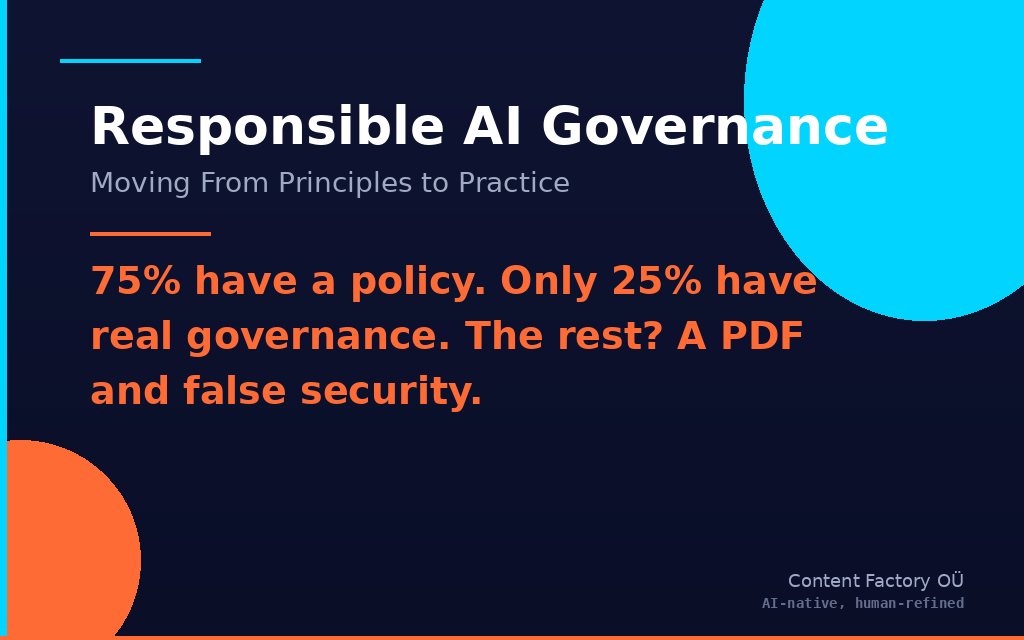
That is not an insult. It is a statistic. Seventy-five percent of organizations have an AI usage policy on file. Only twenty-five percent have actually implemented a governance program that means anything. The rest have a document, a signature page, and a false sense of security.
If you think a policy equals protection, you are in for a painful surprise. Ninety-seven percent of organizations that suffered an AI breach did not lack rules. They lacked access controls. Only thirteen percent have human oversight policies in place. A staggering 2.3 percent maintain any kind of complaint mechanism. The gap is not between having principles and wanting them. It is between writing them down and living them.
At Content Factory, we believe AI handles scale, humans provide soul. That applies to governance too. You can automate monitoring, flagging, and documentation. You cannot automate judgment, accountability, or the decision to stop a model before it harms someone. The organizations that get this right in 2026 will not be the ones with the longest policy documents. They will be the ones with the shortest distance between a rule and its enforcement.
The Three Frameworks You Cannot Ignore Anymore
Three governance frameworks now shape every serious conversation about responsible AI. You do not need to be a compliance officer to understand them. You do need to know which one applies to you and when.
The EU AI Act
This is the big one. Legally binding. Risk-based. Applicable to any AI system that touches the EU market, regardless of where your company is headquartered.
The timeline is real and it is accelerating. General-purpose AI rules and national authority designations took effect in August 2025. The majority of provisions — including high-risk AI system requirements and transparency obligations — become enforceable in August 2026. Critical sector rules for biometrics, infrastructure, and education follow in December 2027.
Penalties reach up to seven percent of global annual turnover. This is not a guidance document. It is a law with teeth, and the countdown is shorter than most organizations realize.
NIST AI Risk Management Framework
Voluntary in the United States, but increasingly treated as a baseline expectation for federal procurement and enterprise B2B relationships. The framework organizes risk management into four functions: Govern, Map, Measure, and Manage.
The 2025 and 2026 updates specifically address generative AI risks — hallucinations, data leakage, and supply chain exposure. It integrates cleanly with SOC 2 and ISO 27001, which makes it a practical starting point for organizations already running security compliance programs.
ISO/IEC 42001:2023
This is the first certifiable international standard for AI Management Systems. Published in December 2023, with accreditation bodies active since late 2024, it covers governance, risk management, transparency, accountability, fairness, security, safety, and privacy.
ISO 42001 is increasingly recognized as a practical pathway to EU AI Act alignment. Certification takes four to six months for small and mid-sized organizations, and six to twelve months for enterprises. It is valid for three years with annual surveillance audits. For B2B companies and anyone bidding on government contracts, it is quickly becoming a de facto prerequisite.
The Policy vs. Practice Gap: Where Governance Actually Fails
Most AI governance failures are not dramatic headline events. They are quiet operational breakdowns that compound over time until something breaks publicly.
Here is what the data actually says about where organizations fall short.
Thirty-six to fifty-four percent of organizations have adopted a formal governance framework. That means nearly half have no structured oversight, no defined KPIs, and no regular review process. They have principles without process.
Eighty-four percent of ethics and compliance teams manage third-party risk. Only fifteen percent extend AI-specific safeguards to vendor contracts. Your suppliers could be using AI in ways that expose your data, your customers, and your liability, and you may have no contractual mechanism to stop it.
Eighty-three percent of European professionals report using AI at work. Only thirty-one percent of their employers have a formal AI usage policy. That gap is shadow AI — ungoverned, invisible, and growing. Every employee using a generative AI tool without guidance is a governance incident waiting to happen.
Forty-eight percent of companies integrate ethical principles into their AI strategies. Ninety-seven percent ignore environmental impact. This is the ESG disconnect in AI governance: leaders talk about fairness and transparency while the carbon footprint and resource consumption of their models go unmeasured.
The pattern is consistent. Organizations invest in policy creation and underinvest in enforcement. They publish principles and skip the infrastructure that makes principles operational.
What Good Governance Looks Like When Nobody Is Watching
There is a revealing absence in the public record. Search for AI governance failures and you will find plenty: Microsoft halting an image generator after political misinformation, McDonald’s nearly exposing data for sixty-four million applicants through default admin credentials, financial models replicating historical bias, and legal AI generating false court citations.
Search for celebrated case studies of governance done well and the results are thin. Organizations that implement strong governance tend not to publicize it. Good governance is invisible by design. It prevents problems rather than responding to them, which makes it hard to turn into a press release.
That creates both a challenge and an opportunity. The challenge is that there are few public models to copy. The opportunity is that early movers can define what responsible governance looks like in their industries before regulators force the issue.
Here is what it looks like in practice.
An 8-Step Framework for Operationalizing AI Governance
These steps are not theoretical. They are the checklist we use with clients who need governance that survives an audit, a breach, or a regulator’s questions.
1. Inventory and risk-classify every AI system
Catalog everything. Not just the models you built. The third-party tools your teams use. The APIs you integrated. The embedded AI in software you already bought. Classify each by risk tier: prohibited, high-risk, limited risk, or minimal risk under the EU AI Act framework. If you do not know what AI you have, you cannot govern it.
2. Establish a cross-functional governance committee
Legal, ethics, engineering, product, and business representation. Not a working group that meets quarterly. A committee with decision rights, escalation authority, and a mandate to stop deployments. Governance without power is theater.
3. Adopt a framework and map it to your organization
Pick one: NIST AI RMF, ISO 42001, or EU AI Act alignment. Map its functions to your actual processes. Do not copy the framework document. Translate it into your operating model, your review gates, and your approval workflows.
4. Operationalize policies into checklists and gates
The worst place for a governance rule is a PDF. The best place is a CI/CD pipeline, a procurement checklist, or a model review gate. Turn principles into yes-no questions that block progress when the answer is wrong. If a policy does not change what someone does on a Monday morning, it is not operationalized.
5. Implement continuous monitoring
Track model drift, bias metrics, incident rates, and human override rates. Set thresholds that trigger review. Only fifty-four percent of organizations have incident response playbooks. Build one specific to AI failure modes, not a generic IT incident template with “AI” searched and replaced in.
6. Extend governance to third parties
Audit your vendor contracts for AI clauses. Require documentation, access controls, and incident reporting from any supplier using AI on your behalf. The fifteen percent of organizations that already do this are building a compliance moat. The rest are building liability.
7. Build incident response playbooks for AI-specific failures
A hallucination in a customer-facing tool is not a generic bug. A biased hiring model is not a routine quality issue. A data leak through an AI integration is not a standard security incident. Each requires a specific response protocol, assigned owners, and communication templates. Build them before you need them.
8. Maintain documentation and traceability
The EU AI Act requires it. ISO 42001 audits for it. Your future self will thank you for it. Maintain model cards, data lineage records, and decision logs. Know what model version was running, what data it trained on, who approved the deployment, and what the known limitations were.
Why August 2026 Matters More Than You Think
The EU AI Act enforcement timeline is not abstract. In August 2026, the majority of provisions become enforceable. High-risk AI systems in employment, finance, healthcare, education, and law enforcement will need to meet conformity assessment requirements. Transparency obligations for chatbots and deepfakes take full effect.
If your organization touches the EU market and you have not started the compliance timeline, you are already behind. Certification takes months. Documentation takes months. Policy operationalization takes months. The organizations that treat this as a 2027 problem will be scrambling in late 2026 while their competitors have already passed audit.
The Governance Maturity Model: Where Do You Stand?
Most maturity models describe five levels. For practical purposes, three matter in 2026.
Level 1: Ad Hoc. AI usage is happening without oversight. Policies are reactive or nonexistent. This describes the majority of organizations with shadow AI.
Level 2: Managed. Policies exist, a committee meets, and some review happens. But enforcement is inconsistent and documentation is patchy. This describes many organizations with a governance PDF.
Level 3: Defined. Frameworks are adopted, policies are operationalized into workflows, monitoring is continuous, and third-party safeguards are in place. This is the 2026 minimum for responsible scaling.
If you are below Level 3, your governance posture is not just incomplete. It is a liability that grows with every new AI system you deploy.
Governance Is Not a Cost Center Anymore
The organizations that treat AI governance as a compliance tax will fall behind the ones that treat it as a strategic advantage. ISO 42001 certification is becoming a B2B trust signal. Customers and partners are starting to ask for it. Procurement teams are adding AI governance clauses to vendor questionnaires.
Ninety percent of companies have not publicly committed to a named AI governance framework. That means the first ten percent to do so — and mean it — will differentiate themselves in markets where trust is scarce and skepticism is high.
Good governance is not about avoiding fines. It is about building organizations that can deploy AI confidently, scale it responsibly, and explain their decisions when asked.
Make Governance Something You Live, Not Something You File
If your AI governance exists only in a document, you do not have governance. You have a draft. The gap between policy and practice is where reputations, customers, and legal standing get lost.
Content Factory helps organizations operationalize AI governance with practical frameworks, documentation systems, and review workflows that turn principles into enforceable practice. If you need governance that holds up under real scrutiny — not just in a board presentation — talk to us.
Content Factory OÜ
AI-native, human-refined content production
https://contentfactory.ltd