Why Brand Voice Dies When You Automate Content — The Brand Voice Automation Warning
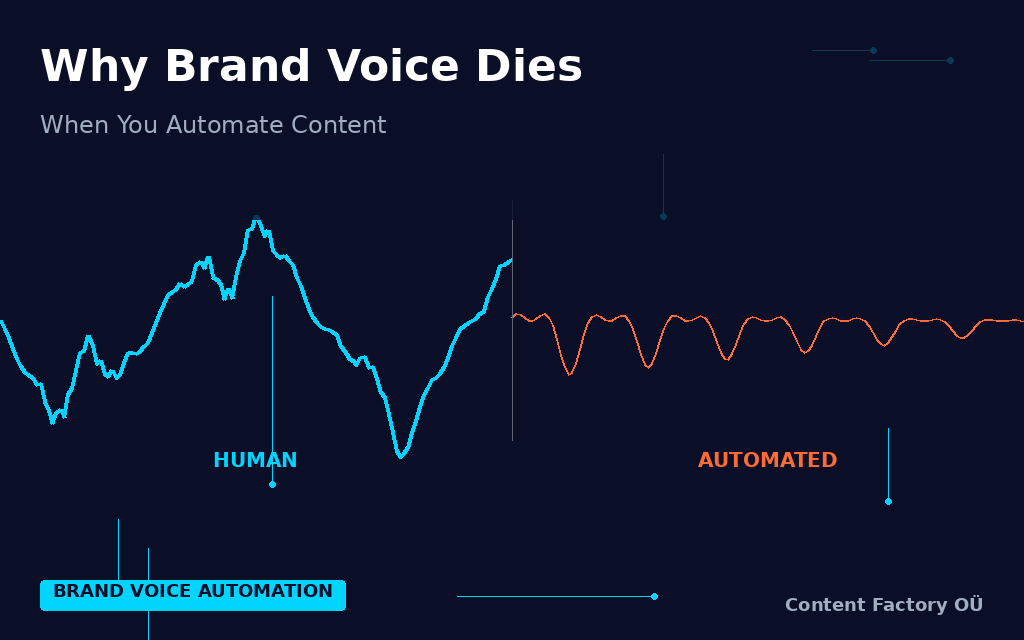
Why Brand Voice Dies When You Automate Content — The Brand Voice Automation Warning
The Promise: AI Content at Infinite Scale
In 2026, the pitch for brand voice automation is irresistible. One prompt. Thirty seconds. A thousand words of polished, grammatically flawless content ready to publish. AI writing tools have crossed the threshold from novelty to infrastructure — and marketing teams are under pressure to adopt them at scale.
The business case writes itself:
- Content production costs drop by 60–80% when AI handles first drafts
- Publishing velocity increases 5–10× without adding headcount
- Multilingual expansion becomes a checkbox instead of a six-month project
- A/B testing at scale is finally feasible for lean teams
For CMOs staring down quarterly targets and flat budgets, AI content automation looks like the lever they’ve been waiting for. And in many ways, it is.
But there’s a problem nobody puts on the slide deck: the more you automate, the more your brand sounds like everyone else.
Where Voice Gets Lost: The Mechanics of AI Sameness
AI language models don’t have opinions. They don’t have history with your customers. They don’t know that your founder quit a Fortune 500 job because she believed “marketing should feel like a conversation, not a campaign.” What they have is a statistical average of everything they’ve read — billions of documents, weighted by frequency, normalized into the safest possible output.
This produces five predictable failure modes that kill brand voice:
1. The Generic Middle
AI defaults to consensus. It avoids controversy, flattens personality, and sands off the edges that make your brand memorable. The result is content that reads like it was written by a committee of everyone — which means it connects with no one.
In 2026, marketers report that generic-sounding content remains a top concern, with AI outputs often lacking originality, depth, and personality. The “average” tone that models produce is precisely what makes brands disappear.
2. Structural Repetition
Feed the same brief to an AI tool five times, and you’ll get five variations of the same structure: the problem-solution-benefit arc, the “In today’s fast-paced world” opener, the “It’s important to note that” transition. These patterns are training-data fossils — and audiences are learning to recognize them as “AI speak.”
83% of consumers actively avoid content they detect as AI-generated. The structural giveaways aren’t subtle anymore. They’re brand poison.
3. Emotional Hollow Points
AI can simulate enthusiasm. It cannot simulate the specific enthusiasm of a team that spent three years refining a product after their first version failed. It can write a customer success story, but it cannot capture the particular relief in a founder’s voice when she describes the moment everything finally clicked.
Authentic storytelling, personalized messaging, and subtle human “imperfections” resonate deeply with audiences. Over-reliance on AI makes content feel distant, impersonal, even “soulless.”
4. The Nuance Translation Problem
Your brand voice isn’t a list of adjectives. It’s a set of micro-decisions: when to be formal versus casual, when to use jargon versus plain language, when to lead with emotion versus data. Translating these subjective elements into quantifiable instructions for AI models remains a complex, unsolved challenge.
Most “brand voice” prompts are too thin to produce differentiation. They produce consistency — but consistent mediocrity is still mediocrity.
5. Channel Drift at Scale
The same AI model writing your website copy, LinkedIn posts, and email newsletters will produce structurally similar output across all three. But your website voice should be authoritative. Your LinkedIn voice should be conversational. Your email voice should be intimate. Ensuring a consistent yet adapted brand voice across channels becomes increasingly complex at scale — and ungoverned AI weakens overall brand recognition.
Case Studies: When Automation Eats the Brand
The failure modes aren’t theoretical. Here are four brands that learned the hard way in 2025–2026.
McDonald’s Netherlands: The “Soulless” AI Holiday Ad
In December 2025, McDonald’s Netherlands released a 45-second AI-generated holiday commercial. The concept was clever — chaotic holiday scenes suggesting McDonald’s as an escape. The execution was catastrophic.
Viewers described the ad as “soulless,” “creepy,” “unsettling,” and “pure slop.” Generic-looking AI characters and an inauthentic feel “ruined Christmas spirit.” McDonald’s pulled the video after just three days, acknowledging the moment “served as an important learning as we explore the effective use of AI.”
The lesson: When emotional context matters — and it always matters — AI alone cannot carry the brand.
Coca-Cola: Doubling Down on “Digital Slop”
Coca-Cola released AI-generated Christmas ads in both 2024 and 2025. Both faced backlash.
The 2024 campaign was criticized as “uncanny eyesores” with awkward animation and “eerie-looking AI humans.” For 2025, Coca-Cola “doubled down” with technically improved ads featuring anthropomorphic animals. Social media responded with “anger and disgust.” Critics called the output “soulless,” “lifeless,” and “an imitation of nostalgia rather than the real thing.”
Coca-Cola’s Global VP of Generative AI claimed the 2024 ad “performed exceptionally well” in private testing. The public backlash suggests a dangerous gap between internal metrics and actual brand perception.
The lesson: Technical improvement without voice governance just produces higher-quality mediocrity.
Bumble: When Voice Governance Fails (Even Without AI)
Bumble’s 2024–2025 anti-celibacy campaign wasn’t AI-generated — but it illustrates the same failure mode. Messaging like “You know full well a vow of celibacy is not the answer” directly contradicted Bumble’s historical brand voice as a female-first, empowerment-focused platform.
The result: widespread criticism, users deleting the app, and a public apology. Whether the breakdown comes from AI or human-created content that bypasses voice governance, the result is identical — when messaging departs from brand identity, audiences react with rejection.
The lesson: Voice governance isn’t an AI problem. It’s a brand problem. AI just makes it happen faster.
Meta’s AI Ads: Chaos at Scale
A July 2026 Business Insider investigation revealed that Meta’s AI ad-generation tools are causing widespread brand chaos. Brands report AI-generated creatives with misrepresentations and absurdities, requiring extensive manual review that undermines the automation promise.
The risk isn’t just creative quality — it’s trust-critical brand damage when ungoverned AI output goes live without human verification.
The lesson: Automation without governance is not a cost savings. It’s a liability accelerator.
How to Preserve Brand Voice in a Brand Voice Automation Workflow
The solution is not to abandon AI. The brands winning in 2026 are those deploying a human-AI hybrid model — using AI for speed and scale while preserving human editorial judgment, strategic voice definition, and final quality control.
The performance data is clear:
– AI + human expert editing performs 34% better than purely AI-generated content
– AI-assisted workflows show +12% productivity gain vs. non-AI workflows
– Teams tracking AI-specific KPIs see 2.4× better content ROI
Here’s the four-stage framework leading enterprises have converged on:
Stage 1: Strategy & Briefing (Human-Owned)
Before any AI touches the content, a human strategist defines:
– Audience segment and emotional state
– Core message and key supporting points
– Voice requirements for this specific piece
– Channel-specific formatting rules
– What not to say
This briefing is the voice contract. AI operates within its constraints — or it operates blindly.
Stage 2: AI Production (Machine-Executed)
AI generates the first draft, structural content, variations, and platform adaptations. But it does so within a controlled environment:
– Machine-readable brand voice frameworks embedded as system-level context (Custom GPTs, Claude Projects, Gemini Gems)
– Approved and banned vocabulary lists
– Sentence structure specifications (short/punchy vs. flowing; active vs. passive voice)
– “Do-not-say” lists to prevent AI default phrases
Traditional PDF style guides fail with AI because they require human interpretation. The 2026 standard is AI-operable voice guidelines that constrain output at the model level.
Stage 3: Human Refinement (The Critical Gate)
This is where voice is preserved or lost. A human editor reviews every piece for:
– Brand voice alignment (not just “on-brand” but distinctively on-brand)
– Emotional resonance and authentic storytelling
– Fact-checking and source verification
– Channel-specific tone adaptation
– Elimination of AI-pattern giveaways
No content ships without human editorial sign-off. This is non-negotiable.
Stage 4: Governance & Iteration (Continuous)
- Mandatory human review for all public-facing AI-generated content
- Automated brand guideline checks using AI platforms that flag voice inconsistencies
- Regular auditing of published AI content to identify voice drift
- Performance feedback loops that refine the voice framework based on what actually resonates
The Siegel+Gale Insight: Clarity Before Automation
Siegel+Gale, one of the world’s leading brand strategy firms, argues that AI will usher in a “golden age of brand voice” — but only for brands with clarity and coherence.
Their key insight: AI makes brand voice easier to maintain, stronger, more dynamic, and more intentional — but only if the brand identity was clear to begin with. Without well-defined brand identity, AI amplifies inconsistencies and makes a brand disappear into the generic hum.
The future is humans setting strategy, AI handling execution — consistently outperforming purely AI-generated content. But the sequence matters. Strategy first. Then automation.
The Content Factory Approach: Human → AI → Human
At Content Factory, we built our production pipeline specifically to prevent the voice-dilution problems documented above.
Our operating principle: Generic AI content is “the fast food of the internet — cheap, abundant, and forgettable.” We are building something else: AI-native production with human editorial judgment baked into every layer.
The Three-Layer Hybrid Workflow
| Layer | Function | Voice Protection Mechanism |
|---|---|---|
| Layer 1: Human Strategist | Defines audience, goals, messaging, and voice requirements | Ensures strategic alignment before any AI touches the content |
| Layer 2: AI Production | Generates drafts, structures content, optimizes for platforms | Operates within brand-voice constraints encoded as system-level prompts and proprietary training data |
| Layer 3: Human Editor | Refines voice, injects nuance, verifies facts, ensures emotional resonance | The critical voice-retention gate — no content ships without human editorial sign-off |
This maps directly to the four-stage best-practice framework validated by 2026 market research. The 70/30 Hybrid Blueprint — 70% human strategy and judgment, 30% AI execution — is emerging as the standard across content operations.
Proprietary Voice Encoding
Generic AI produces generic results. Our differentiator is training AI on proprietary brand assets:
- Feed AI models 10–15 pieces of high-performing, on-brand content to extract stylistic patterns
- Use 15,000+ words of brand-specific long-form content for deep tone calibration
- Create prompt libraries aligned with brand tone that writers can adapt
- Continuously refine based on performance feedback and audience response
This creates a competitive moat: a brand voice trained on proprietary data is difficult for competitors to replicate.
Why This Matters for Earned Media
A 2026 Cision State of the Media report found that 53% of journalists are opposed to receiving AI-generated pitches or press releases. A UK-specific survey of 200 journalists found 76% oppose AI-generated media pitches.
Journalists cite lack of personalization, generic quality, factual inaccuracies, and loss of authenticity as primary concerns. Some have begun using AI detection software to reject content that fails checks.
For brands seeking earned media coverage, the hybrid model isn’t a preference — it’s essential. AI-assisted research and drafting are acceptable; AI-only pitching is a coverage killer.
The Model Collapse Threat: Why Voice Will Become the Scarcest Commodity
“Model collapse” is the degenerative process where AI models trained primarily on AI-generated content enter a recursive feedback loop, progressively degrading output quality and diversity. Rare or nuanced brand voice information is particularly vulnerable to being lost.
Experts warn this is not theoretical — it is already underway. As AI content saturates channels, authentic human insight and original perspectives become the scarcest and most valuable commodities.
Brands that rely on ungoverned AI output are not just risking inconsistency — they are participating in a race to the bottom where all voices converge into one generic hum. The brands that survive will be those that used AI to multiply their output while protecting the human insight that makes their voice worth hearing.
The Audit: Is Your Brand Voice Surviving Automation?
Run this five-question check on your current AI content workflow:
1. Do you have machine-readable brand voice guidelines?
If no → Your AI is operating without a map. Start by distilling voice into 3–5 adjectives with explicit behavioral rules.
2. Does a human review every piece before publication?
If no → You are accepting ungoverned AI output as your brand voice. The trust erosion is measurable.
3. Are you training AI on your proprietary content?
If no → Your AI is producing the statistical average of the internet. That is not a differentiation strategy.
4. Do you measure voice-specific KPIs, or just volume?
If volume only → You are optimizing for output, not impact. Track sentiment, engagement quality, and brand recall.
5. Do you disclose AI use appropriately?
If concealed → You are risking accelerated trust collapse. Brands that disclose AI use are rated more trustworthy.
Answer “no” to any of these, and you have a voice vulnerability.
The Bottom Line
AI content automation in 2026 is not optional. The productivity gains are real, the cost savings are substantial, and the competitive pressure to adopt is intense. But automation without voice governance is not scaling — it’s self-sabotage.
58% of consumers trust brands less if they use AI-generated content. 50% prefer brands that do not use generative AI in customer-facing communications. 83% avoid content they identify as AI-generated.
These numbers will not improve as AI gets better. They will get worse — because as AI content becomes more ubiquitous, the brands that preserved their human voice will stand out more dramatically.
The winning strategy is not anti-AI. It is AI-native production with human editorial judgment baked into every layer. Use AI to multiply your output. Use humans to protect the brand voice that makes the content worth producing in the first place.
At Content Factory, we built that workflow because the alternative — generic, forgettable, “AI slop” — is not a brand strategy. It’s a slow surrender.
The gap between the brands that automate intelligently and the brands that automate blindly is where the next 12 months of competitive advantage will be won.
Which side are you on?
Want to audit your brand voice against AI automation risks? Talk to Content Factory about a voice governance assessment and pilot program.
Featured Image: linkedin-image-brand-voice-automation_20260724.png
Authors: Claire Brand (Marketing) & Valeria Looks (Design / Visual Brand)
Research: Sarah Deepsight
Publication Date: July 24, 2026
Sources: Klaviyo 2026 AI Consumer Trends Report, Gartner GenAI Content Quality Survey June 2026, Gartner Consumer AI Preferences March 2026, TD Bank 2026 AI Insights Report, The Wits Lab AI Content Flood 2026, Search Engine Land AI Trust Decline Study 2026, Forbes Agency Council June 2026, Siegel+Gale Golden Age of Brand Voice, Semrush AI Marketing Guide 2026, Digital Applied Content Marketing Statistics 2026, DotDigital 2026 Marketing Predictions, Fast Company Preserve Your Brand Voice, Cision State of the Media 2026, Presswire Journalist Survey 2026, The Guardian, Mashable, Forbes, TechRadar, Business Insider, YouGov. Full source index available in Content Factory research archives.