Building Loyalty: Retention Strategies for Hybrid Human-Agent Teams
By Claire Brand & Sarah Deepsight | June 2026
Here is the retention paradox nobody talks about: companies invest millions in AI to cut costs, then watch their best people walk out because they never invested in the human side of the transition.
AI-assisted onboarding and screening improve new hire retention by 82%. AI-powered retention analytics can predict flight risks with 20-30% accuracy. The tools exist. The data is available. Yet retention in AI-integrated teams is getting worse, not better, at companies that treat AI as a cost-cutting lever instead of a workforce enabler.
The problem is not the technology. It is the fear.
Employees are not afraid of AI itself. They are afraid of being made obsolete. They are afraid of biased algorithms making promotion decisions. They are afraid of AI monitoring their productivity. They are afraid of asking questions that make them look like they do not understand the new tools. That fear kills innovation, destroys trust, and drives turnover.
The companies winning the retention war are not the ones with the best AI. They are the ones with the best psychological safety.
Why Psychological Safety Is the Hidden Retention Driver
Psychological safety is the belief that one can speak up, take risks, ask questions, and admit mistakes without fear of punishment. In AI-integrated workplaces, this matters more than ever because AI-driven changes create constant uncertainty around roles, skills, and performance expectations.
When employees feel psychologically safe, they innovate. They identify AI errors before those errors reach customers. They view AI as an opportunity to become more valuable, not a threat to their employment. When they do not feel safe, they quiet-quit on AI. They use the tools minimally, hide their confusion, and update their resumes.
The leadership behavior that creates psychological safety is specific and observable. Leaders must admit when they do not understand an AI recommendation. They must ask questions about algorithmic decisions in team meetings. They must share their own mistakes with AI tools. Vulnerability from the top signals that not knowing is acceptable — and that learning is the expectation.
The 86% Expectation: AI Training Is Now a Retention Requirement
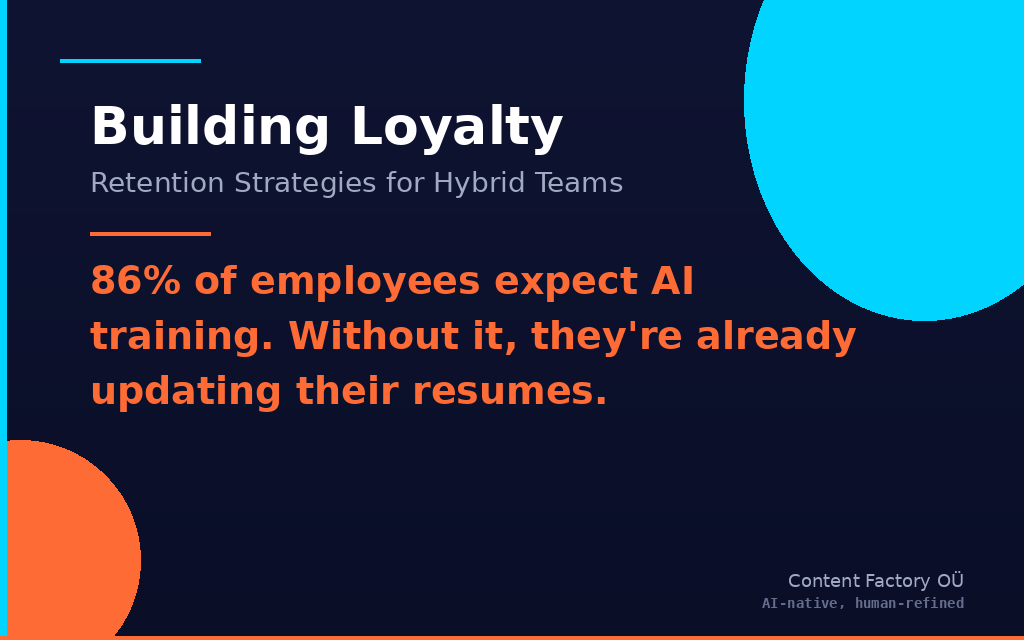
By 2025, 86% of employees expected AI-related training from their employers. That is not a nice-to-have anymore. It is a baseline expectation. Companies that fail to provide it are now explicitly at retention risk.
The 56% wage premium for AI skills makes the economics clear. Employees with AI proficiencies command significantly higher compensation. Companies that train internally fill roles up to 6x cheaper than external hires and boost retention in the process. Upskilling is not an expense. It is a retention investment with a measurable return.
AI itself can help design these learning experiences. Individualized training programs that identify skill gaps and recommend modules are already available. The same technology that displaces tasks can accelerate human capability. The difference is intent: are you using AI to replace people, or to make them more valuable?
Five Proven Retention Strategies for Hybrid Teams
1. Cultivate openness and trust with AI transparency
Fear thrives in opacity. When employees do not understand how AI tools function, what data they use, or how decisions are made, they fill the gaps with worst-case assumptions.
Implement regular “AI Transparency Sessions” where teams discuss how AI tools work and collaboratively develop best practices. Explicitly define which tasks are best suited for AI versus human judgment. When employees understand their irreplaceable value — creativity, empathy, complex problem-solving, ethical judgment — they stop seeing AI as competition.
2. Invest in continuous, personalized learning
Generic AI training is almost as bad as no training. Employees need learning paths matched to their roles, skill gaps, and career trajectories.
Use AI to design individualized learning experiences. Map current capabilities against future needs. Recommend specific training modules. Track progress. Celebrate completion. And tie learning directly to career advancement: show employees how new skills translate to new opportunities within the company.
The companies retaining the best people are not just teaching them to use AI tools. They are teaching them to lead AI-integrated teams, design AI workflows, and interpret AI outputs at a strategic level.
3. Prioritize well-being and redefine flexibility
AI integration creates new stressors: faster pace, higher output expectations, constant tool changes, and the cognitive load of human-AI collaboration.
Strengthen mental health support with expanded wellness programs, counseling access, and mental health days. Redefine flexibility to focus on results rather than hours. The hybrid workforce model is now mainstream. The companies that retain talent are the ones that measure output and impact, not keystrokes and availability.
4. Enhance communication with AI-powered feedback loops
Implement AI-powered tools to collect and analyze employee feedback, allowing HR to address concerns proactively. But do not stop at collection. Establish safe check-ins where employees can share experiences with AI tools without fear of judgment.
The feedback loop must be bidirectional. Employees need to know that their concerns about AI are heard and acted upon. When they report a biased algorithm, a confusing interface, or an unfair productivity metric, the response must be prompt and transparent. Silence breeds resignation — both the emotional kind and the professional kind.
5. Reimagine HR with predictive retention analytics
AI-powered retention analytics predict flight risks with 20-30% accuracy. That is not perfect, but it is enough to enable proactive intervention.
Use predictive data to identify employees showing disengagement signals: reduced collaboration, declining learning participation, negative feedback trends, or reduced AI tool adoption. Then intervene with targeted conversations, role adjustments, or development opportunities before the resignation letter arrives.
AI can also help mitigate unconscious bias in hiring and promotion, promoting diversity and inclusion. Fairer processes create more loyal workforces.
The Retention Checklist for AI-Integrated Teams
For leaders who want to act immediately, here is a practical checklist.
- Audit psychological safety: Survey your team anonymously. Do they feel safe admitting AI confusion? Do they trust leadership’s intent around AI?
- Map AI task boundaries: Document which tasks are AI-led, which are human-led, and which are collaborative. Share this transparently.
- Launch an AI training program: Start with role-specific modules, not generic overviews. Tie completion to career development.
- Implement retention analytics: Deploy flight-risk prediction and act on the signals within 48 hours.
- Create feedback channels: Establish safe, anonymous ways for employees to raise AI concerns without career risk.
- Review compensation for AI skills: Ensure internal AI upskilling is rewarded competitively. The 56% external premium will poach your people if you do not match it.
- Measure retention by team: Track which teams are losing people and correlate with AI integration intensity, leadership quality, and training access.
What the Retention Leaders Do Differently
Companies that retain talent in AI-integrated environments share one trait: they design the human experience first and layer AI on top. They do not deploy AI and hope the culture adapts. They adapt the culture deliberately.
These companies start retention conversations before AI rollout begins. They involve employees in tool selection and workflow design. They communicate the “why” behind every automation decision. They create explicit career pathways that show how AI integration creates advancement, not displacement.
They also measure what matters. Retention rate is a lagging indicator. Leading indicators — psychological safety scores, training completion rates, AI tool adoption curves, internal mobility rates — tell you whether people are planning to stay long before they resign.
The best teams treat AI integration as a change management exercise, not a technology deployment. They know that the fastest way to waste an AI investment is to lose the people who were supposed to use it.
The Real Lesson: Retention Is a Design Problem, Not an HR Problem
Retention in hybrid teams does not improve through better exit interviews. It improves through better design: transparent communication, clear task boundaries, continuous learning, fair compensation, and psychological safety built into the operating model.
AI can predict who is leaving. It can automate onboarding. It can personalize training. It can reduce bias. But it cannot replace the human judgment required to build a workplace where people want to stay.
The companies that get this right will have lower turnover, higher innovation, and better AI adoption. The companies that get it wrong will have expensive hiring cycles, quiet quitting, and AI tools that never reach their potential because the humans using them have already checked out.
AI handles scale. Humans provide soul. Retention requires both.
Content Factory helps companies design AI-integrated workforce strategies that retain talent, build psychological safety, and turn AI adoption into a competitive advantage. If your best people are updating their resumes, talk to us before they submit them.
Content Factory OÜ
AI-native, human-refined content production
https://contentfactory.ltd