
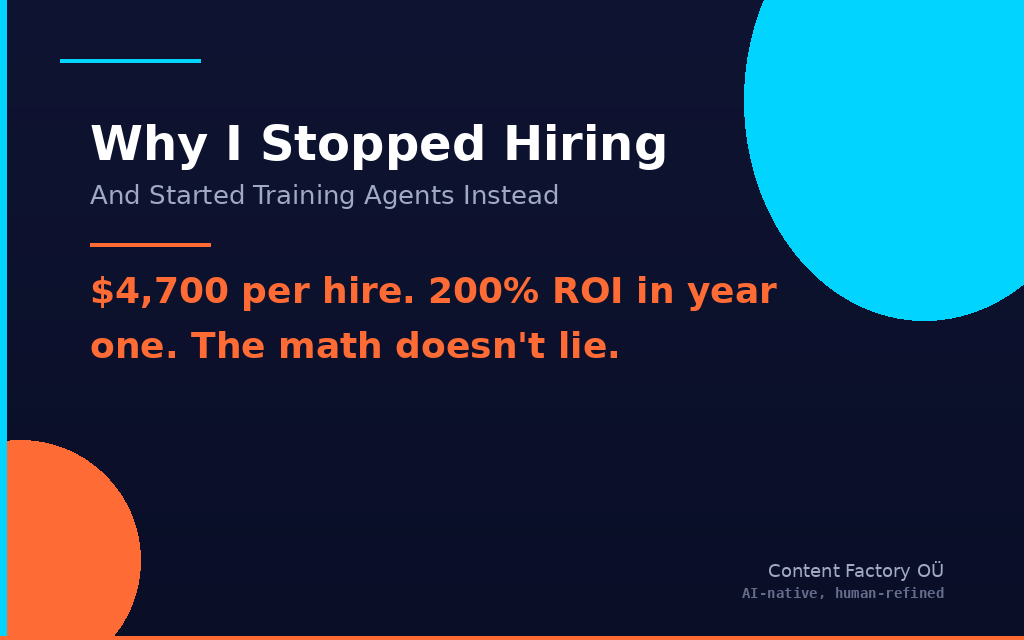
Why I Stopped Hiring and Started Training Agents Instead
By Patrick C. Price & Rick Bucks | June 2026
I used to believe that scaling a company meant scaling headcount. More revenue meant more people. More complexity meant more departments. More customers meant more seats.
I was wrong.
The shift did not happen overnight. It started with a spreadsheet and a frustrating realization: we were spending $4,700 per hire, on average, and external agencies were charging 15-30% of first-year salary. For a mid-level role at $80,000, that meant $12,000 to $24,000 in agency fees alone. And that was before onboarding, training, equipment, benefits, and the three to six months it takes most hires to become productive.
Then I looked at what those hires were actually doing. Document review. Data entry. Renewal tracking. Supplier comparison. Report generation. Meeting scheduling. Status updates. A significant portion of the work was repetitive, rule-based, and document-heavy. The kind of work humans do badly when bored and agents do consistently when trained.
So I asked a question I had never seriously considered: what if I trained an agent instead of hiring a person?
The $4,700 Question
The math is what convinced me. Not philosophy. Not hype. Math.
AI recruitment tools can reduce hiring costs by 20-50%. Unilever cut hiring costs by 50% through AI assessments. But that still assumes you need to hire. I started wondering whether I needed to hire at all for certain functions.
AI tool subscriptions range from $50 to $1,500 per month. Break-even against traditional hiring typically happens within 3-6 months. Workforce automation delivers an average ROI of 200% within the first year, with 20-60% cost savings for suitable processes. Early adopters of agentic AI report 88% positive ROI.
By 2025, 65% of global businesses had implemented workflow automation. 80% were expected to adopt intelligent automation. This was not an edge case. It was becoming the default.
I started small. One agent for contract renewal tracking. One agent for supplier benchmark preparation. One agent for internal report generation. The results were immediate: recruiters spent 70-80% less time on manual resume reviews, and time-to-hire dropped 30-50% for the roles we still filled. But the bigger shift was that we stopped needing to fill some roles entirely.
What I Actually Stopped Doing
I did not fire anyone to make room for agents. I stopped creating new positions for work that agents could handle.
The functions that shifted first were the boring ones: extracting terms from contracts, monitoring renewal dates, normalizing supplier quotes, flagging duplicate subscriptions, preparing benchmark comparisons, generating weekly status reports, and scheduling meetings across time zones. These tasks are essential. They are also exactly the kind of repetitive, deadline-sensitive, comparison-heavy work that humans sustain poorly over time.
AI saves employees 2-4 hours per day on suitable tasks. Output quality improves 25-35%. Innovation time increases 50-100%. Error rates for repetitive administrative tasks drop by up to 75%. My team did not become smaller. They became sharper. They spent less time on maintenance and more time on strategy.
The Klarna case is the extreme end of this spectrum but worth understanding. Their AI assistant projected $40 million in profit improvement in its first year, handling two-thirds of customer service conversations — equivalent to 700 full-time agents. I am not running Klarna. Most companies are not. But the principle scales: agents handle volume; humans handle judgment.
What I Learned the Hard Way
Not every role can be agent-replaced. I learned this through failure.
I tried an agent for vendor relationship management. It failed. Negotiation requires reading the room, understanding unspoken priorities, and making trade-offs in real time. An agent can prepare the battlefield. It cannot sit across the table.
I tried an agent for creative concept development. It produced competent, generic ideas. It did not produce breakthroughs. Creativity requires taste, risk, and the willingness to be wrong in interesting ways. Agents optimize for patterns. Breakthroughs break patterns.
I tried an agent for executive decision support. It summarized data well. It did not synthesize insight. Strategic judgment requires context, experience, and the courage to bet against the data when intuition says the data is incomplete.
These failures taught me something important: agent deployment is not about replacing humans. It is about reallocating human potential to higher-value work. The goal is not fewer people. It is better use of people.
The Roles I Still Hire Humans For
This is the part that matters. I am not anti-human. I am anti-waste.
I still hire for roles that require creativity, complex problem-solving, emotional intelligence, ethical judgment, relationship management, strategic thinking, and leadership. These are not luxuries. They are competitive advantages that agents cannot replicate.
Only 7% of CEOs foresee AI replacing a strategic executive assistant in the next decade. That tells you something: even at the top of the automation curve, there are roles that remain fundamentally human. The question is not whether AI can do the job. It is whether the job is better done by a machine or a person.
18% of CEOs have replaced fundamental administrative roles with AI, primarily for repetitive data tasks. That number will grow. But the roles that remain — the ones that require judgment, empathy, and strategic thinking — will become more valuable, not less.
The Workforce Transition Framework We Used
For teams considering this shift, here is the framework that worked for us.
1. Identify
Map every role and task in your organization. Classify each as rule-based, pattern-based, or judgment-based. Rule-based tasks are the easiest to automate. Judgment-based tasks should stay human.
2. Automate
Start with one category of rule-based work. Build an agent to handle it. Measure output quality, error rates, and time savings. Do not scale until the first agent is reliable.
3. Upskill
Invest the savings from automation into training the humans who used to do those tasks. 86% of employees expect AI-related training. Provide it. Teach them to lead agent workflows, interpret agent outputs, and handle the judgment-based work that agents cannot do.
4. Redeploy
Move people to higher-value roles. A contract analyst who used to extract terms can now manage vendor strategy. A recruiter who used to screen resumes can now build employer brand. The work changes. The people become more valuable.
5. Measure
Track total cost of ownership, not just subscription costs. Include training, maintenance, oversight, iteration, and the opportunity cost of human time reallocated. Compare against the cost of hiring for equivalent output.
The Ethical Dimension
I get the question constantly: “Are you replacing people?”
My answer is no. I am replacing bad jobs with better ones. I am replacing repetitive administrative work with strategic, creative, and relationship-oriented work. I am replacing burnout with engagement.
The companies that handle this transition ethically are transparent about what is changing and why. They invest in reskilling. They give people time to adapt. They do not surprise anyone with automation.
The companies that handle it badly treat people as costs to cut. Those companies will lose their best people — not to agents, but to competitors who treat humans as assets to develop.
The Agent Team at Content Factory
We practice what we preach. Content Factory runs a hybrid team of humans and agents. Our agents handle content research, draft generation, translation first passes, SEO optimization, and scheduling. Our humans handle strategy, editorial judgment, client relationships, creative direction, and final approval.
This is not theory. It is our daily operating model. And it works because we designed it around a simple principle: AI handles scale, humans provide soul.
The Bottom Line
Traditional hiring made sense when the only way to scale output was to scale headcount. That era is ending. Agents can now handle a growing share of repetitive, rule-based work at a fraction of the cost and with higher consistency.
The companies that win the next decade will not be the ones with the most employees. They will be the ones with the best allocation of human and agent capability. They will hire for judgment, creativity, and leadership. They will train agents for repetition, scale, and speed.
That is the shift I made. It was uncomfortable. It required unlearning assumptions I had held for years. But the results speak for themselves: lower costs, faster output, happier humans doing better work, and a company that scales without bloating.
If you are still hiring the way you hired five years ago, ask yourself whether every new role truly requires a human — or whether you are just following a playbook that no longer fits the game.
This post reflects my personal perspective and experience. Your mileage may vary. Draft for review and feedback.
Content Factory OÜ
AI-native, human-refined content production
https://contentfactory.ltd