Inside a Human-AI Content Creation Agency: How the Best Teams Work in 2026
Meta Title: Inside a Human-AI Content Creation Agency: Structure, Pricing & Workflows in 2026
Meta Description: Discover how a human AI content creation agency operates in 2026. Explore team structures, pricing models, workflows, and real case studies from leading hybrid agencies.
The agencies winning in 2026 are not the ones with the biggest teams. They are the ones that figured out how to make humans and AI collaborate at scale. A human AI content creation agency is no longer a traditional shop with a few AI tools bolted on. It is a fundamentally different operational model — one where intelligent automation handles execution and humans own strategy, quality, and relationships.
This shift is not theoretical. In 2026, hybrid agencies are producing three to five times more content with the same headcount, cutting time-to-first-draft by 75%, and lowering cost-per-article by 40% — all while maintaining (and often improving) quality. The competitive moat is no longer access to tools. It is the workflow that connects them.
In this article, we break down how a modern human-AI agency is structured, how it prices its services, how it actually works day-to-day, and what separates the leaders from the laggers.
What Defines a Human-AI Content Creation Agency in 2026?
A human-AI content creation agency operates on a collaborative model, leveraging artificial intelligence for efficiency and scale while retaining human expertise for strategic oversight, creativity, and quality assurance. This hybrid approach is considered crucial for maintaining authenticity, accuracy, and ethical standards in content generation.
The distinction matters. Any agency can buy a Jasper subscription. The agencies thriving in 2026 have built complete workflows where AI agents handle research, drafting, optimization, and publishing — while human experts focus on the decisions that software cannot make: brand positioning, client strategy, creative direction, and ethical judgment.
This is not about replacing teams. It is about removing the friction that slows them down.
Key insight: The agencies that treat AI as a co-pilot rather than a replacement are the ones seeing measurable ROI. Those that treat it as a cheap ghostwriter are eroding their brand authority.
The New Agency Org Chart: Roles That Matter
The team structure of a human-AI content creation agency has evolved beyond traditional titles. In 2026, the org chart includes roles that did not exist three years ago — and some legacy roles have been redefined entirely.
Core Human Roles
| Role | Responsibility |
|---|---|
| Chief Content Officer / Content Strategist | Defines overarching content vision and ensures alignment with client business goals. Guides the “why” and “how” of every piece. |
| Managing Editor / Creative Leader | Owns quality assurance, brand voice consistency, design integrity, and messaging effectiveness. |
| Content Manager / Traffic Manager | Coordinates the entire workflow, manages human and AI creators, oversees editorial calendars, and ensures timely delivery. |
| Content Writers (Human) | Refine AI drafts, inject personality, add nuanced examples, and develop original thought leadership that AI cannot replicate. |
| Subject Matter Experts (SMEs) | Validate accuracy, relevance, and ethical soundness for specialized or sensitive topics. |
| SEO Specialist / Strategist | Drives in-depth keyword research, technical SEO analysis, and on-page optimization — often using AI tools to accelerate the work. |
| AI / Prompt Engineer | Designs, refines, and manages prompts; trains specialized AI assistants for specific content outcomes. A newer, critical role. |
| Data Analyst / AI Insights Agent | Interprets AI-generated insights, tracks performance metrics, and makes data-driven recommendations. |
| Ethics & Compliance Officer | Ensures AI-generated content adheres to ethical standards, inclusivity guidelines, and legal compliance. |
Emerging Structure: The “Pod” Model
Some agencies are abandoning the traditional department structure in favor of small, multidisciplinary “pods” — each containing a strategist, designer, writer, and project manager assigned to specific clients or campaigns. Pods operate autonomously, reducing handoff delays and increasing accountability.
The lesson for founders and marketing leaders: if your agency does not have a prompt engineer or an ethics review stage in 2026, you are operating with a 2023 playbook.
Pricing Models: What Human-AI Agencies Actually Charge
Pricing in the hybrid agency world has shifted away from hourly rates and seat-based retainers. In 2026, the most successful agencies price for outcomes, not hours.
Common Pricing Models
| Model | Price Range | Best For |
|---|---|---|
| Monthly Retainer (General) | $2,000–$20,000+/mo | Ongoing content partnerships |
| AI SEO Retainer | $2,000–$20,000+/mo | Search-focused clients |
| AI Creative Production | €4,000–€21,500/mo | High-volume paid media brands |
| Productized Services | $997–$4,500/mo | Scalable, repeatable offerings |
| Outcome-Based / Performance | $1,200 base + $45/qualified lead | Results-focused businesses |
| Hybrid Retainer | $4,000 base + variable for new workflows | AI Operations monitoring |
| Agent Licensing | $20,000 setup + $2,000/mo license | Custom AI agent IP ownership |
| Hourly (Consulting) | $175–$350/hr for AI specialists | Discovery, advisory |
Real-World Examples
- AI Content Engine: $1,800/month or $180 per AI-assisted blog post
- AI UGC-Style Videos: $1,500–$4,000/month or $100–$300 per creative
- CRM Lead-Routing Automation: $6,500 flat project fee
- Performance-Based: $2,000/mo retainer + 5% bonus when revenue target is met
AI agency services often command 20–50% higher rates than traditional digital marketing due to enhanced speed, scale, and performance outcomes. Clients are willing to pay more when they can see the output volume and speed increase in real time.
The Five-Stage Workflow: How Human-AI Agencies Actually Work
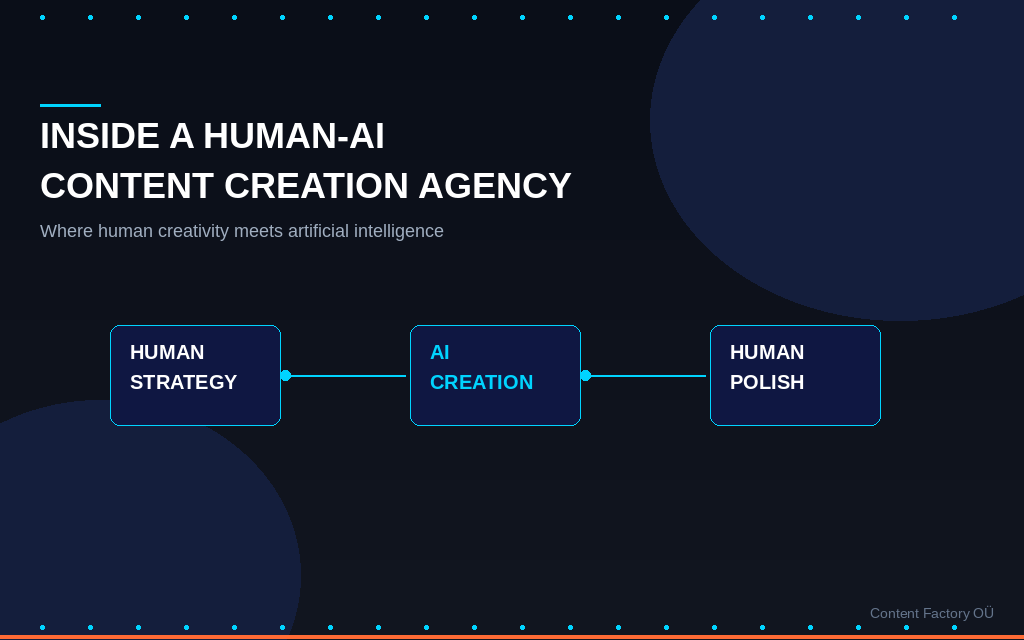
A typical human-AI content agency workflow is built around five stages. AI acts as a co-pilot at every step — but human judgment is the non-negotiable gate between each one.
Stage 1: Intake & Briefing
Human strategists define objectives, target audience, key messages, and desired outcomes. AI tools assist in initial research by gathering competitive intelligence and audience insights.
Stage 2: Ideation & Planning
AI rapidly generates topic angles, headline variations, keyword themes, and content outlines based on the brief and SEO data. This accelerates brainstorming and ensures search intent alignment.
Stage 3: Drafting & Creation
Specialized AI agents generate initial drafts for blog posts, social media, ad copy, email newsletters, and video scripts. Agencies with AI-first pipelines produce 3–5× more content with the same team.
Stage 4: Human Review & Refinement
This is the critical differentiator. Human writers, editors, and SMEs review for:
– Factual accuracy
– Brand voice consistency
– Appropriate tone
– Ethical considerations
– Legal compliance
– Emotional resonance and unique perspectives
Skipping this stage is how agencies end up with AI hallucinations in client-facing content and reputational damage they cannot undo.
Stage 5: Optimization & Distribution
AI tools optimize content for various platforms, generate meta tags, and aid in performance analysis. In 2026, the goal is not just traditional SEO — it is Answer Engine Optimization (AEO) and Generative Engine Optimization (GEO) in an AI-first search landscape. Human-AI agencies now optimize for ChatGPT, Claude, and Perplexity as discovery platforms, not just Google.
Proof It Works: Case Studies From 2026
The data is no longer speculative.
Apex Digital Strategies
A mid-sized B2B marketing agency redesigned their processes from the ground up in early 2026:
– 75% reduction in time-to-first-draft
– 40% decrease in cost-per-article
– 200% increase in monthly content output
– Before AI: a 1,500-word blog post took 3–4 weeks
– After AI: same output in under 1 week with higher quality
Superside
A high-volume AI creative production agency saved clients $3.5 million across 3,000+ AI-powered projects by embedding generative tools directly into their design workflow.
Jellyfish
An AI-integrated media buying specialist achieved a 65% reduction in campaign launch times and a 30% performance improvement by automating creative adaptation and placement optimization.
Monks (Monks.Flow)
An AI Pioneer Organization delivered 62% higher conversion rates and 13% lower cost-per-signup for Headspace by combining predictive audience modeling with generative creative production.
These are not edge cases. They are the benchmarks that clients now expect.
The Tech Stack: Tools Human-AI Agencies Rely On
Tools are commoditized. Workflows are not. Still, the agencies winning in 2026 tend to build their stacks around a consistent set of platforms.
Text & Copy
- Jasper — $39–$59/month; marketing-focused long-form and ad copy
- Claude Pro — $17–$20/month; best for long-form writing and reasoning
- Copy.ai — $24–$29/month chat plan; $1,000+/month for workflow automation
- Writer — $29–$39/user/month; enterprise-grade governance and compliance
Image & Video
- Midjourney — $24/month; high-fidelity visual creation
- Synthesia — enterprise AI avatars for professional video
- Descript — $16–$24/month; video/audio editing with AI transcription
Workflow & Orchestration
- Averi — AI content marketing platform with agentic workflow capabilities
- Content Harmony — content marketing team orchestration
- Brightspot — CMS with AI content workflow integration
The agencies that outperform their competitors are not the ones with the most expensive tools. They are the ones that have integrated these tools into a single, repeatable pipeline with human checkpoints at every stage that matters.
What Separates the Leaders From the Laggers
After reviewing the data, the agencies that are pulling ahead in 2026 share six characteristics:
- They treat the human-AI agency as a distinct category — not a traditional agency using tools, but a fundamentally different operational model.
- They have evolved team structures — prompt engineers, AI strategists, and ethics officers are core roles, not experimental hires.
- They price for value, not hours — outcome-based and consumption-based models are replacing traditional retainers.
- They are 3–5× more productive — but only because human review is treated as a non-negotiable stage, not an afterthought.
- Their competitive moat is process, not tools — any agency can buy Jasper; few can build a workflow that consistently produces quality at scale.
- They optimize for AI assistants, not just search engines — GEO and AEO are now standard practice.
The Bottom Line
A human AI content creation agency in 2026 is not a novelty. It is the new standard. The agencies that have rebuilt their workflows around human-AI collaboration are delivering more content, faster, at lower cost, with measurable quality improvements. The ones that have not are already being underpriced and outpaced.
If you are evaluating agency partners — or building an in-house content operation — the question is no longer “Are you using AI?” It is “How have you redesigned your team and workflow around it?”
The answer to that question is what separates the leaders from everyone else.
Published by Content Factory | Idealizer GmbH | July 10, 2026